How Much Does Invisalign Treatment Cost in West Sussex? Treatment Options and What to Expect
If you’re considering straightening your teeth, one of your first questions is likely to be, how much does Invisalign treatment cost?
This guide explains Invisalign treatment costs in West Sussex, the different treatment options, what happens during the process and how to decide whether clear aligners are right for you.
How Much Does Invisalign Treatment Cost in West Sussex?
The cost of Invisalign treatment in West Sussex varies according to individual dental needs and the type of treatment recommended.
A review of advertised Invisalign starting prices at eight selected dental practices serving West Sussex in October 2026 found an average of approximately £2,800, with advertised prices ranging from £1,800 to £3,500. These figures represent a limited sample of advertised starting prices rather than the average final cost of treatment. Individual prices and package inclusions vary between providers.
At Mallards Dental Practice in Henfield, Invisalign treatment starts from £2,500 for suitable cases involving relatively minor tooth alignment concerns. More complex treatment may cost more. Following a clinical assessment, patients will receive a personalised written quotation outlining their recommended treatment, total cost and any additional charges.
Invisalign Treatment Options and Costs
| Treatment option | Suitable for | Typical treatment scope |
| Invisalign Express | Minor spacing or crowding | Limited tooth movements using fewer aligners |
| Invisalign Lite | Mild to moderate alignment concerns | Shorter treatment plans for selected cases |
| Invisalign Moderate | More involved alignment issues | Intermediate treatment requirements |
| Invisalign Comprehensive | More complex crowding, spacing or bite concerns | More extensive tooth movement and potential refinements |
The exact product options available will depend on the dental provider and individual treatment plan.
What Factors Affect the Cost of Invisalign Treatment?
Two patients may receive different Invisalign quotations, even if their teeth initially appear to have similar alignment concerns.
Several factors influence the overall cost.
1. Complexity of Teeth Alignment
The position of your teeth and the extent of correction required are major factors in determining treatment costs.
For example, someone with a small gap between their front teeth may require a different treatment plan from someone with significant crowding or a complicated bite.
Invisalign may help manage certain cases involving:
- Crowded or overlapping teeth
- Gaps between teeth
- Mild to moderate alignment irregularities
- Some overbite, underbite or crossbite concerns
- Teeth that have shifted following previous orthodontic treatment
However, not every alignment or bite problem can be managed effectively with Invisalign alone. Some patients may benefit more from fixed braces, other orthodontic appliances or specialist orthodontic assessment.
2. Number of Aligners and Treatment Duration
Invisalign works through a series of custom-made aligners that apply controlled forces to gradually reposition teeth.
Cases requiring relatively small movements may need fewer aligners. More involved cases often require additional stages and longer treatment.
Your dentist will estimate the number of aligners needed during treatment planning, although the final duration may change depending on how your teeth respond.
3. Additional Dental Treatment
Before starting orthodontic treatment, your teeth and gums should be healthy. If you have untreated tooth decay, active gum disease or other oral health concerns, these may need to be managed before aligners are fitted.
Additional procedures can affect the overall cost and timeline.
It’s also worth asking whether your quotation includes:
- Digital scans and treatment planning
- All planned aligners
- Routine progress appointments
- Additional refinement aligners, where required
- Retainers following treatment
- Replacement aligners if any are lost or damaged
A transparent quotation makes it easier to understand the total financial commitment.
4. Treatment Planning and Clinical Supervision
Successful orthodontic care requires more than simply providing clear plastic aligners.
A qualified dental professional must assess your oral health, identify the cause of alignment concerns, plan appropriate tooth movements and monitor your progress.
Regular supervision also allows potential problems to be identified and managed during treatment.
When comparing providers in West Sussex, consider the quality of the assessment, the clarity of the treatment plan and the arrangements for ongoing care, rather than focusing on price alone.
What Invisalign Treatment Options Are Available?
Invisalign offers different treatment approaches depending on the extent of tooth movement required. Your dentist will recommend an appropriate option following a clinical examination.
Invisalign Express: For Minor Corrections
Invisalign Express is intended for selected cases requiring relatively limited tooth movement.
It may be considered for small gaps, minor crowding or teeth that have moved slightly following previous orthodontic treatment.
Because the treatment involves a limited number of aligners, it may take less time than more comprehensive approaches.
However, it is not suitable for all cases, and a shorter treatment does not necessarily mean better results.
Invisalign Lite: For Mild to Moderate Alignment Issues
Invisalign Lite may be considered for selected mild to moderate alignment concerns.
It can involve more tooth movement than very limited aligner treatments while remaining less extensive than a comprehensive treatment plan.
The suitability of this approach depends on factors such as your bite, tooth position and overall dental health.
Invisalign Moderate: For More Involved Cases
Invisalign Moderate is an intermediate option that some providers may offer for cases requiring more movement than shorter treatment packages allow.
Not every dental practice offers every Invisalign package, and your dentist will explain which options are clinically appropriate and available.
Invisalign Comprehensive: For More Complex Cases
Invisalign Comprehensive is designed for cases requiring more extensive treatment planning and tooth movement.
It may be considered for patients with more significant crowding, spacing or certain bite issues.
Treatment may involve additional aligners and refinements to help achieve the planned alignment.
Even comprehensive clear aligner treatment has limitations. Some complex cases may require conventional fixed braces or assessment by a specialist orthodontist.
What to Expect During Your Invisalign Treatment in Henfield
Understanding the treatment process can make it easier to prepare for appointments and decide whether Invisalign fits your lifestyle.
Although every patient’s treatment plan differs, the general process follows several stages.
Step 1: Your Initial Invisalign Consultation
Your journey begins with a dental consultation to assess your teeth, gums and bite.
The dentist will ask about your concerns, examine your oral health and discuss the changes you would like to achieve.
Digital scans may be taken to record the current position of your teeth and support treatment planning.
At Mallards Dental Practice in Henfield, an Invisalign consultation is advertised at £25, including a digital scan and a 3D preview. The practice states that this fee is credited towards treatment if you proceed.
A digital preview can help explain the proposed tooth movements, but it is a simulation rather than a guarantee of the final result.
Step 2: Digital Treatment Planning
If Invisalign is considered suitable, a personalised treatment plan is prepared.
This involves mapping the proposed movement of your teeth through a sequence of aligners.
Your dentist will explain the expected treatment duration, any anticipated limitations and the likely costs.
This is also an opportunity to discuss alternatives, potential risks and whether any preparatory dental treatment is necessary.
Step 3: Receiving Your Invisalign Aligners
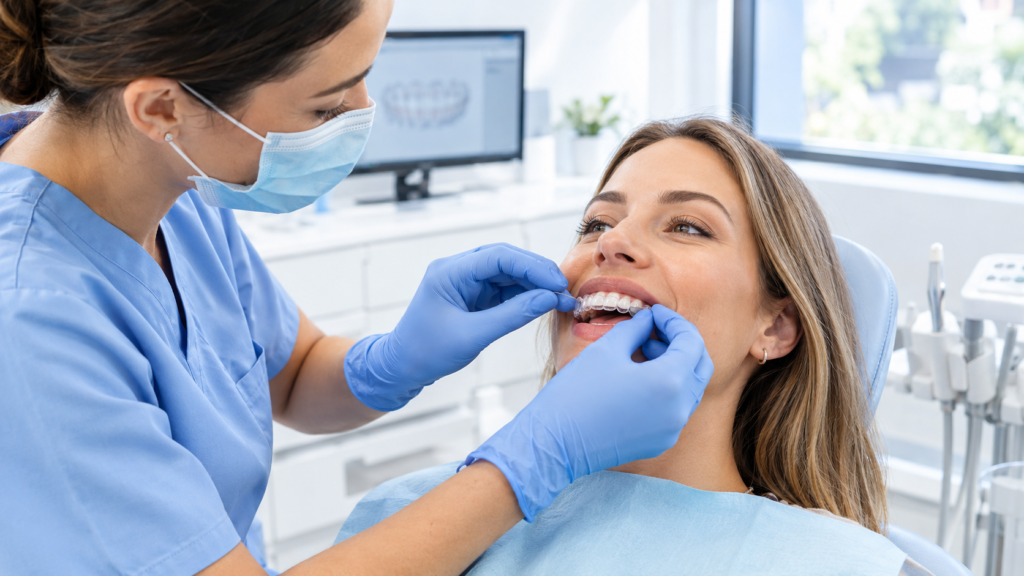
Once your aligners are ready, your dentist will check their fit and explain how to use them.
Invisalign aligners are made from clear plastic and are designed to fit closely over your teeth.
For most patients, aligners should be worn for approximately 20–22 hours each day, following the specific instructions provided by the treating dentist.
They are usually removed when eating, drinking anything other than water, and cleaning your teeth.
Some patients may also need small tooth-coloured attachments to assist with particular movements.
Step 4: Monitoring Your Progress
Throughout treatment, you will attend review appointments to check that your teeth are moving as planned.
At Mallards Dental Practice, Invisalign progress checks are described as taking place approximately every six to eight weeks, although individual schedules may vary.
During these appointments, your dentist can assess aligner fit, review oral hygiene and determine whether any adjustments are needed.
If your teeth are not tracking as expected, additional scans or refinement aligners may be required.
Step 5: Retainers and Long-Term Aftercare
Orthodontic treatment does not end when you finish wearing your last Invisalign aligner.
Teeth can gradually move again after treatment, a process known as orthodontic relapse.
Retainers help maintain their new positions.
Your dentist will explain the type of retainer recommended, how often it should be worn and what follow-up care may be required.
Long-term retainer use is often necessary to help preserve the results of orthodontic treatment.
How Long Does Invisalign Treatment Usually Take?
The duration of Invisalign treatment varies considerably.
For minor alignment concerns, some treatment plans may take approximately three to six months.
More extensive cases may take 12–18 months or longer, depending on the complexity of the required movements and how the teeth respond.
Factors affecting treatment time include:
- The amount of tooth movement required
- The complexity of your bite
- How consistently you wear your aligners
- Whether additional treatment stages are needed
- Your individual biological response to orthodontic treatment
Wearing aligners for fewer hours than prescribed may slow progress and lead to additional appointments or refinements.
Your dentist can provide a more realistic timeframe after assessing your teeth.
Is Invisalign Worth the Cost Compared with Traditional Braces?
When considering Invisalign treatment, it is useful to compare clear aligners with conventional fixed braces.
Both approaches aim to improve tooth alignment, but they have different practical advantages and limitations.
| Feature | Invisalign | Traditional fixed braces |
| Appearance | Clear and less noticeable | Metal brackets and wires are usually visible |
| Removability | Removed for meals and cleaning | Fixed to the teeth throughout treatment |
| Eating | Usually no brace-related food restrictions when aligners are removed | Some foods need to be avoided to prevent damage |
| Oral hygiene | Teeth can be brushed and flossed without aligners in place | Additional cleaning around brackets and wires is required |
| Daily commitment | Requires consistent aligner wear | Does not rely on remembering to wear removable appliances |
| Suitability | Suitable for many, but not all, orthodontic cases | May be preferable for certain complex tooth movements |
| Cost | Depends on the treatment plan and provider | Depends on appliance type, complexity and provider |
Advantages of Invisalign
One of Invisalign’s main benefits is its discreet appearance.
This can appeal to adults who would prefer a less visible orthodontic appliance during work, social activities or everyday conversations.
The ability to remove aligners for eating and brushing also offers practical convenience.
However, Invisalign requires consistent daily use. It may not be the most appropriate option for patients who struggle to wear removable appliances as instructed.
Limitations and Potential Risks
Invisalign is not risk-free, and the decision to proceed should follow a thorough clinical assessment.
Potential considerations include:
- Temporary discomfort or pressure when changing aligners
- Speech changes while adjusting to the appliance
- Gum irritation or problems with aligner fit
- Tooth decay or gum inflammation if oral hygiene is inadequate
- Unwanted tooth movement or changes to the bite
- Gum recession, root shortening or other orthodontic complications in some cases
- Treatment taking longer than initially predicted
- Teeth moving again after treatment if retainers are not worn as advised
Not everyone will experience these problems, but patients should understand the possible risks and alternatives before treatment begins.
Can You Spread the Cost of Invisalign Treatment?
The overall price of Invisalign can be an important consideration, particularly when a more extensive treatment plan is required.
Some private dental practices offer finance arrangements that allow eligible patients to spread their payments over an agreed period. In Henfield, Mallards Dental Practice also offers finance options for eligible Invisalign patients.
Patients should obtain and review the applicable finance terms, including repayment amounts, interest and any additional charges, before applying.
What Should You Check Before Agreeing to a Payment Plan?
Before committing to any finance agreement, make sure you understand:
- The total treatment cost
- Any deposit required
- The amount of each monthly repayment
- The repayment period
- Whether interest or additional charges apply
- What happens if your treatment plan changes
Finance is subject to the relevant provider’s terms and eligibility requirements.
You should also obtain a written treatment estimate confirming which appointments, aligners and aftercare services are included.
Why Consider Invisalign Treatment in Henfield if You Live in Brighton?
Patients exploring teeth-straightening options often compare dental practices across their local area rather than restricting their search to one town.
Henfield is a West Sussex village within reach of Brighton, making it a potential option for patients who prefer to receive dental care outside the city. If you’re searching online for a dentist Brighton residents can visit for teeth straightening, it may also be worth considering Invisalign providers in nearby Henfield.
However, convenience should be considered alongside clinical suitability and the standard of care.
In Henfield, Mallards Dental Practice provides Invisalign treatment through Dr Kasra Kazemian, a GDC-registered dentist (registration number 303658) and certified Invisalign provider.
The practice is located at 2 Mallard Way, Henfield, BN5 9HF, with on-site parking.
For patients travelling from Brighton or surrounding villages, practical considerations such as appointment availability, travel time and ongoing review visits are worth discussing before beginning treatment.
Frequently Asked Questions About Invisalign Treatment
Invisalign treatment at Mallards Dental Practice in Henfield starts from £2,500 for suitable cases. More complex treatment may cost more. Following a clinical assessment, patients can obtain a personalised written quotation explaining the total treatment cost, what is included and any additional charges that may apply.
Not necessarily. The cost of both Invisalign and fixed braces depends on treatment complexity, appliance type and provider fees. For some patients, Invisalign may cost more, while in other cases prices may be comparable. The most appropriate option should be chosen based on clinical needs rather than price alone.
Invisalign can cause temporary pressure, tenderness or discomfort, particularly when switching to a new set of aligners. This often improves as you adjust to them. If you experience persistent or severe pain, contact your treating dentist for advice.
Most Invisalign patients are advised to wear their aligners for approximately 20–22 hours per day. They should generally be removed for meals, drinks other than water and oral hygiene. Follow your dentist’s individual instructions.
Invisalign can be suitable for adults and some teenagers, provided their dental condition and treatment needs are appropriate. Age alone does not determine eligibility. Oral health, tooth development and the complexity of alignment issues are important considerations.
Active gum disease or other untreated dental problems may need to be managed before orthodontic treatment begins. Moving teeth without appropriate periodontal assessment and care may increase the risk of complications. Your dentist will assess the health of your gums before recommending treatment.
The results can be maintained over the long term, but teeth may move after treatment. Wearing retainers as prescribed and attending appropriate dental reviews can help reduce the likelihood of relapse. Permanent results cannot be guaranteed.
Yes. Patients living in Brighton can consider Invisalign treatment in Henfield, provided they are able to attend the necessary consultation and follow-up appointments. The best choice of provider depends on your dental needs, accessibility and personal preferences.
This depends on the provider and the agreed treatment package. Before starting, ask whether retainers, replacement retainers and follow-up visits are included in your written quotation.
Book an Invisalign Consultation in Henfield, West Sussex
Understanding the cost, benefits and limitations of Invisalign is an important part of deciding whether treatment is appropriate for you.
For patients in Henfield, Brighton and surrounding West Sussex communities, a professional dental consultation can help establish whether clear aligners are suitable and what your individual treatment may involve.
Mallards Dental Practice offers Invisalign consultations at its Henfield location, including digital scanning and an initial discussion of treatment options.
If you’re considering Invisalign treatment, you can explore the practice’s Anchor Invisalign information or contact the team to arrange an assessment.